Bronze ware from the Shang Dynasty, "Wine Vessel Gu"

Bronze ware from the Shang Dynasty, "Wine Vessel Gu"

This wine vessel is currently housed in the Minneapolis Museum of Art in the United States. Gu wine vessel is a tall and elegant wine glass with a compact shape, with a trumpet shaped top, gradually narrowing in the middle, and slightly expanding outward at the bottom. Archaeological evidence shows that bronze wine vessels first appeared during the Erligang Culture period of the Shang Dynasty (1500-1300 BC). Gu wine vessels were most popular during the Shang Dynasty (1600-1046 BC), but became relatively rare in the early Western Zhou Dynasty (1046-977 BC) and gradually disappeared during the Eastern Zhou Dynasty (770-256 BC).
7th century Tang Dynasty gilded bronze sculpture "A Pair of Xianglong - Left"
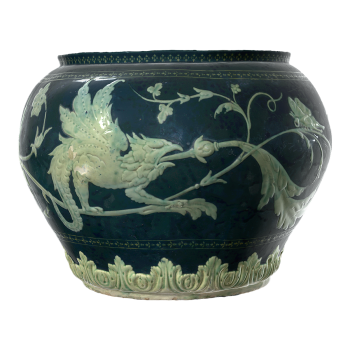
7th century Tang Dynasty gilded bronze sculpture "A Pair of Xianglong - Left"

This Chinese cultural relic is named "A Pair of Xianglong" and was made during the Tang Dynasty in the 7th century. It is made of gold-plated bronze. The dragon is a universal symbol of glory in Chinese culture. As early as the Neolithic Age, the Chinese believed that this mythical creature was an auspicious animal, living in heaven, providing rain and nourishing life. In the late Bronze Age, dragons were equated with emperors. In 221 BC, the great unifier of China and builder of the Great Wall, Qin Shi Huang, declared himself a descendant of dragons. Since then, almost every ruler has been referred to as the "True Dragon Emperor", and the Chinese court is known as the Dragon King constellation, with the official court attire being dragon robes.
The ceramic "Fengxiang Pink Porcelain" from the Jiaqing period of the Qing Dynasty
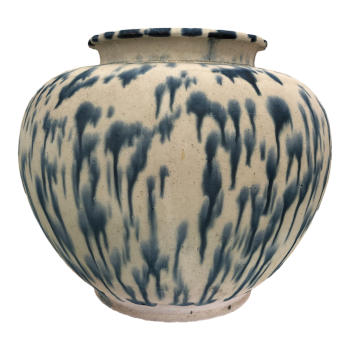
The ceramic "Fengxiang Pink Porcelain" from the Jiaqing period of the Qing Dynasty

This Chinese cultural relic is a porcelain vase from the Jiaqing period of the Qing Dynasty (1796-1820). The vase is made of transparent and colorless underglaze powder colored porcelain, fired in Jingdezhen, and is now collected in the Patna Museum of Art and History.
During the Kaiyuan period of the Tang Dynasty, the ceramic "Tang Dynasty Cobalt Pottery Jar"

During the Kaiyuan period of the Tang Dynasty, the ceramic "Tang Dynasty Cobalt Pottery Jar"

Tang Dynasty cobalt pottery jars are a very rare type of pottery, characterized by the use of cobalt blue glaze. In the Tang Dynasty, cobalt blue glaze was very popular, but due to the high price of high-quality cobalt ore, it was usually only used sparingly. Chinese cobalt ore contains manganese, so its color tends to be darker. The glaze of the jar flows during the firing process, so it stops before the feet, which is a characteristic of Tang Dynasty lead glazed pottery. It is currently housed in the China Ceramic Museum.
Sandstone sculpture from the Northern Wei Dynasty titled 'Stone Statue of Buddha Sitting in Four Sided Shrine'

Sandstone sculpture from the Northern Wei Dynasty titled 'Stone Statue of Buddha Sitting in Four Sided Shrine'

This Chinese cultural relic is a seated Buddha statue in a four sided shrine, made during the Northern Wei Dynasty and carved from sandstone. Unearthed in 1957 in Nanguoshui, Qin County, with severe weathering on the surface, it is collected by the Nanguoshui Stone Carving Museum in Qin County. A total of 4 niches were unearthed, each engraved with 4 Buddha statues.
Jingdezhen Blue and White Porcelain Vase "from the Kangxi period of the Qing Dynasty

Jingdezhen Blue and White Porcelain Vase "from the Kangxi period of the Qing Dynasty

This Chinese cultural relic is a porcelain vase from the Kangxi period of the Qing Dynasty (1662-1722). The vase is made of transparent and colorless underglaze blue and white porcelain with cobalt pigment, fired in Jingdezhen, and is now collected in the Smithsonian Museum.
Statue of Bodhisattva Half Body during the Northern Wei Dynasty

Statue of Bodhisattva Half Body during the Northern Wei Dynasty

The statue is named a half body statue of a Bodhisattva and was made during the Northern Wei Dynasty. The site in front of the Yungang Grottoes was unearthed in 992 and collected by the Yungang Research Institute.
The Yangshao Culture of the Neolithic Age in China's "Colored Pottery Basin with Human Face and Fish Pattern"

The Yangshao Culture of the Neolithic Age in China's "Colored Pottery Basin with Human Face and Fish Pattern"

The Shao culture refers to an important Neolithic colored pottery culture in the middle reaches of the Yellow River, which lasted from approximately 5000 BC to 3000 BC (about 7000 years ago, with a duration of about 2000 years) and was distributed throughout the entire middle reaches of the Yellow River from Gansu Province to Henan Province. It was first discovered in Yangshao Village, Mianchi County, Sanmenxia City, Henan Province in 1921, so according to archaeological conventions, this culture is called the Yangshao culture. It is centered around Guanzhong, western Henan, and southern Shanxi, where the tributaries of the Yellow River, such as Wei, Fen, and Luo, and extends north to the Great Wall and Hetao areas, south to northwest Hubei, and east to eastern Henan. It currently exists at the Central Academy of Historical Research.
Cultural relic from the Qianlong period of the Qing Dynasty: "Recommended Boxes from the Qianlong Period"

Cultural relic from the Qianlong period of the Qing Dynasty: "Recommended Boxes from the Qianlong Period"

In traditional religious beliefs, offering sacrifices or sacrifices is the most common religious behavior. In order to express respect and reverence for gods or ancestors, or to achieve the purpose of communication between humans and gods, people will prepare various foods as sacrificial offerings and offer various types of gold paper as offerings. They will also use various sacrificial and offering utensils to express respect and prayers to the gods, such as shrines, sedan chairs, and other utensils that can be directly used for offerings to the gods; Cups, chopsticks, and poems are used as tools for seeking divine approval; Incense burners, recommendation boxes, and other utensils are used to hold offerings. The utensils used to hold various types of offerings are diverse and complex in variety, and their production techniques and styles are tailored to meet the various forms and purposes of offerings.
The cultural relic of the Shang Dynasty, "Bone shaped Artifacts"

The cultural relic of the Shang Dynasty, "Bone shaped Artifacts"

It is a bone artifact unearthed from the Tomb of Shang Wang No. 1001, possibly made of elephant leg bones, with a complete lower end and a damaged upper end, and a rounded triangular cross-section of the body. On one of the corners of the body, there are two vertically arranged perforations at the lower position of the middle decorative band, which may be used to install handles. The decoration can be roughly divided into three parts. The upper and lower ends of the object are decorated with animal face patterns, the middle part is decorated with the main decoration of Taotie, and the two sides of the triangular pattern below are decorated with inverted dragons. Going further will be the Shen character decorative strip. These patterns are surrounded by dense cloud and thunder patterns, and the carvings are very exquisite. First stored at the Central Institute of Historical Research.
Cultural relic from the late Shang Dynasty, titled 'Turtle Belly Armor with Inscriptions on Zhu Bu'

Cultural relic from the late Shang Dynasty, titled 'Turtle Belly Armor with Inscriptions on Zhu Bu'

This oracle bone belongs to the first Wu Ding divination of the Late Shang Dynasty, which records the divination results of the virtuous man "Wei" on the day of "Bingzi". He used the direct question 'I will receive a good harvest (I will have a good harvest)' and the reverse question 'I will not receive a good harvest (I will not have a good harvest)' to predict whether the crops will have a good harvest this year. The divination inscriptions are usually engraved next to the divination signs, and they usually avoid the divination signs, which is called "avoiding signs"; This edition is inscribed with divination or engraved on divination signs, known as "criminal signs", and currently exists at the Central Institute of Historical Research.
During the Tang Dynasty, the white stone sculpture "Changyang Taizun Stone Statue" was created

During the Tang Dynasty, the white stone sculpture "Changyang Taizun Stone Statue" was created

The Changyang Taizun stone statue was first carved in the seventh year of the Tang Kaiyuan era (719 AD) and is a precious resource for studying Taoism, ancient sculpture, and calligraphy art. The statue is made of white stone, one meter high, dressed in court attire, wearing a crown, with one hand supporting the knee and the other holding a belt, sitting on a stone seat with a dignified expression and smooth clothing patterns. Fuxi is one meter tall, with a bun on his head and curly long hair draped over his shoulders. He is wearing a shoulder and apron connected by leaves, holding the Bagua Taiji diagram in his hand, symbolizing Fuxi's creation of the Book of Changes.
Porcelain "Sacrificial Blue Sky Ball Vase" from the Qianlong period of the Qing Dynasty

Porcelain "Sacrificial Blue Sky Ball Vase" from the Qianlong period of the Qing Dynasty

This vessel shape appeared during the Ming Xuande period, with a large and upright body, a majestic aura, and a sturdy and antique shape. It is named after its round and bulging belly resembling a spherical shape. The sacrificial blue glaze is often used during sacrificial ceremonies, hence it is called sacrificial blue glaze. It is also known as Jilan or Gemstone Blue.
The Double Phoenix Jade Pendant from the Zhou Dynasty
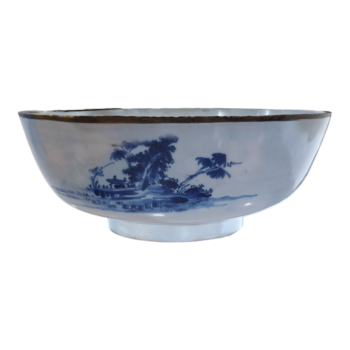
The Double Phoenix Jade Pendant from the Zhou Dynasty

This jade pendant is from Tomb 60 of Liuli Ri in Hui County, Henan Province, and was buried together with the deceased. This light green jade piece is in the shape of two phoenixes, with a circular overall shape. The hollow carving imitates the shape and decoration of the work. The two sides of the pendant rotate upwards to form the head of a phoenix, while their circular bodies are connected to each other. A carved line surrounds the edge of the decoration, outlining the shape of a phoenix, while the entire piece is filled with curled cloud patterns. The pattern on the back of the pendant does not match its shape, indicating that the pendant was remade from an old piece of jade and is now housed in the National Museum of China.
Porcelain bowl with copper edge inlaid with blue and white porcelain from the Qianlong period of the Qing Dynasty
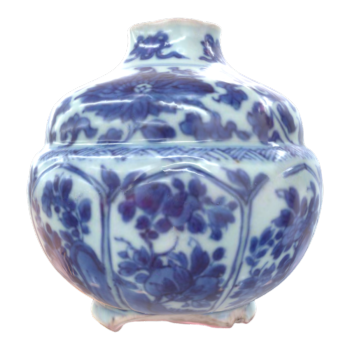
Porcelain bowl with copper edge inlaid with blue and white porcelain from the Qianlong period of the Qing Dynasty

The blue and white porcelain bowls made during the Qianlong period of the Qing Dynasty are now preserved in the Hunt Museum in England. The outer edge of the bowl is decorated with a Pegasus frame,
Jingde Blue and White Porcelain Vase from the Kangxi period of the Qing Dynasty

Jingde Blue and White Porcelain Vase from the Kangxi period of the Qing Dynasty

This Chinese cultural relic is a blue and white porcelain trumpet shaped vase fired in Jingdezhen during the Kangxi reign of the Qing Dynasty. The vase is decorated with fresh flowers and leaves, measuring 11cm in height, 11cm in width, and 11cm in length. It is currently housed in the Hunt Museum in the United Kingdom.
"Terra Cotta Warriors and Horses and Troops"
"Terra Cotta Warriors and Horses and Troops"

The Terra Cotta Warriors, namely the Terra Cotta Warriors in the the Mausoleum of the First Qin Emperor, also referred to as the Terra Cotta Warriors or the Terracotta Warriors, are among the first batch of national key cultural relics protection units and the first batch of Chinese world heritage sites. A charioteer refers to a soldier on a chariot, excluding the rider and driver. There are usually two soldiers on a chariot, namely the left chariot figurine and the right chariot figurine. The figurine on the left side of the carriage is dressed in a long robe, covered in armor, with leg guards on the shin and a crossbeam on the head. It holds weapons such as spears, spears, and halberds in its left hand, and presses the carriage in its right hand. The attire of the figurine on the right side of the car is the same as that of the figurine on the left side, but the posture is opposite. They are both the main force of tank warfare, but according to literature records, they have certain differences in weapon configuration and combat responsibilities.
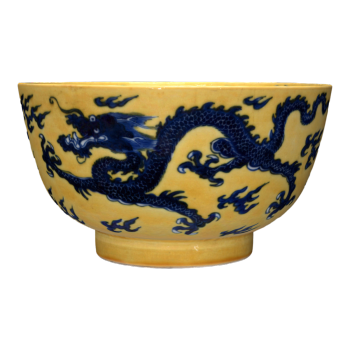
Porcelain "Imperial Yellow Glazed Porcelain Bowl" from the Qianlong period of the Qing Dynasty

Porcelain "Imperial Yellow Glazed Porcelain Bowl" from the Qianlong period of the Qing Dynasty

Yellow glazed porcelain is the most royal style artwork. Since the Han Dynasty, official kilns throughout history have fired yellow porcelain, but before the Ming Dynasty, yellow glazed porcelain did not show true yellow color, but rather yellow brown or dark yellow. Until the Hongzhi period of the Ming Dynasty, the firing of yellow porcelain truly reached its peak, and because the yellow glaze was pure, it was also known as "chicken oil yellow" by later generations. For feudal rulers, yellow was associated with wealth and auspiciousness, gradually transforming into a color used by the royal family and becoming a symbol of power and nobility.
Jingdezhen Blue and White Porcelain Vase "from the Kangxi period of the Qing Dynasty

Jingdezhen Blue and White Porcelain Vase "from the Kangxi period of the Qing Dynasty

This Chinese cultural relic is a porcelain vase from the Kangxi period of the Qing Dynasty (1662-1722). The vase is made of transparent and colorless underglaze blue and white porcelain with cobalt pigment, fired in Jingdezhen, and is now collected in the Smithsonian Museum.
Terracotta Warriors and Horses of the Qin Dynasty

Terracotta Warriors and Horses of the Qin Dynasty

In terms of identity, it is lower than the general figurine and can be classified as intermediate or lower level. The number of Qin terracotta warriors in the pit is extremely small, with less than ten unearthed, divided into two categories: the warrior robe general terracotta warriors and the armored general terracotta warriors. The armored general figurine appears to have a double or single crown on its head, and there are several different forms of armor worn. The terracotta warriors in battle robes are dressed in plain attire, but have floral knots on their chests. The front, back, and shoulders of the armored terracotta warriors are adorned with eight colorful floral knots, which are gorgeous, colorful, and elegant, highlighting their rank, identity, and majesty in the military.
Bronze Pegasus Collected by Minneapolis Institute of the Arts

Bronze Pegasus Collected by Minneapolis Institute of the Arts

When the envoy sent to Central Asia returned to the court, he was amazed by this unique "heavenly horse". This robust animal has a strong back and shoulders, and works very hard, sweating profusely. Emperor Wu of China (141-87 BC) was fascinated by these stories and sent diplomats and later an army to obtain these horses. His interest in these extraordinary horses, as well as the increasingly important role of horses in military operations, largely indicates the popularity of horses in art since the Han Dynasty, especially during the rule of the Wu Kingdom. Bronze horses like this are placed in exquisitely decorated noble tombs.
Bronze square cauldrons from the early Western Zhou Dynasty collected by the Minneapolis Institute of Art

Bronze square cauldrons from the early Western Zhou Dynasty collected by the Minneapolis Institute of Art

Ding is a utensil used by ancient Chinese people in some places to cook and store meat, and is one of the most important bronze ware species in ancient times. The "ding" (cooking vessel) is considered by later generations to be the most representative of supreme power among all bronze vessels.
Bronze Tripod of Early Western Zhou Dynasty Collected by Minneapolis Academy of Arts

Bronze Tripod of Early Western Zhou Dynasty Collected by Minneapolis Academy of Arts

Porcelain from the Wanli period of the Ming Dynasty, titled 'Silver Gold Plated Inlaid Blue and White Porcelain Bowl'

Porcelain from the Wanli period of the Ming Dynasty, titled 'Silver Gold Plated Inlaid Blue and White Porcelain Bowl'

The blue and white porcelain bowl made during the Wanli period of the Ming Dynasty (1573-1619) is currently preserved in the Hunt Museum in England. The outer edge of the bowl is decorated with a Pegasus frame, and the bowl wall is decorated with flower spray.